- Immersed
- Posts
- Stop Fighting Your Phone Addiction (Redirect It To Fluency Instead)
Stop Fighting Your Phone Addiction (Redirect It To Fluency Instead)
The same trap that steals your time can build your fluency... if you redirect it.

Ademola Adeyemi
November 22, 2025

Your phone addiction isn't the problem. Your algorithm's language is.
There are two scroll wheels in the modern learner's life, and they look identical from the outside. Both glow with the same blue light. Both promise "just one more video." Both hijack our thumbs with algorithmic precision.
But one is a black hole. The other is a ladder to fluency.
The Two Scroll Wheels
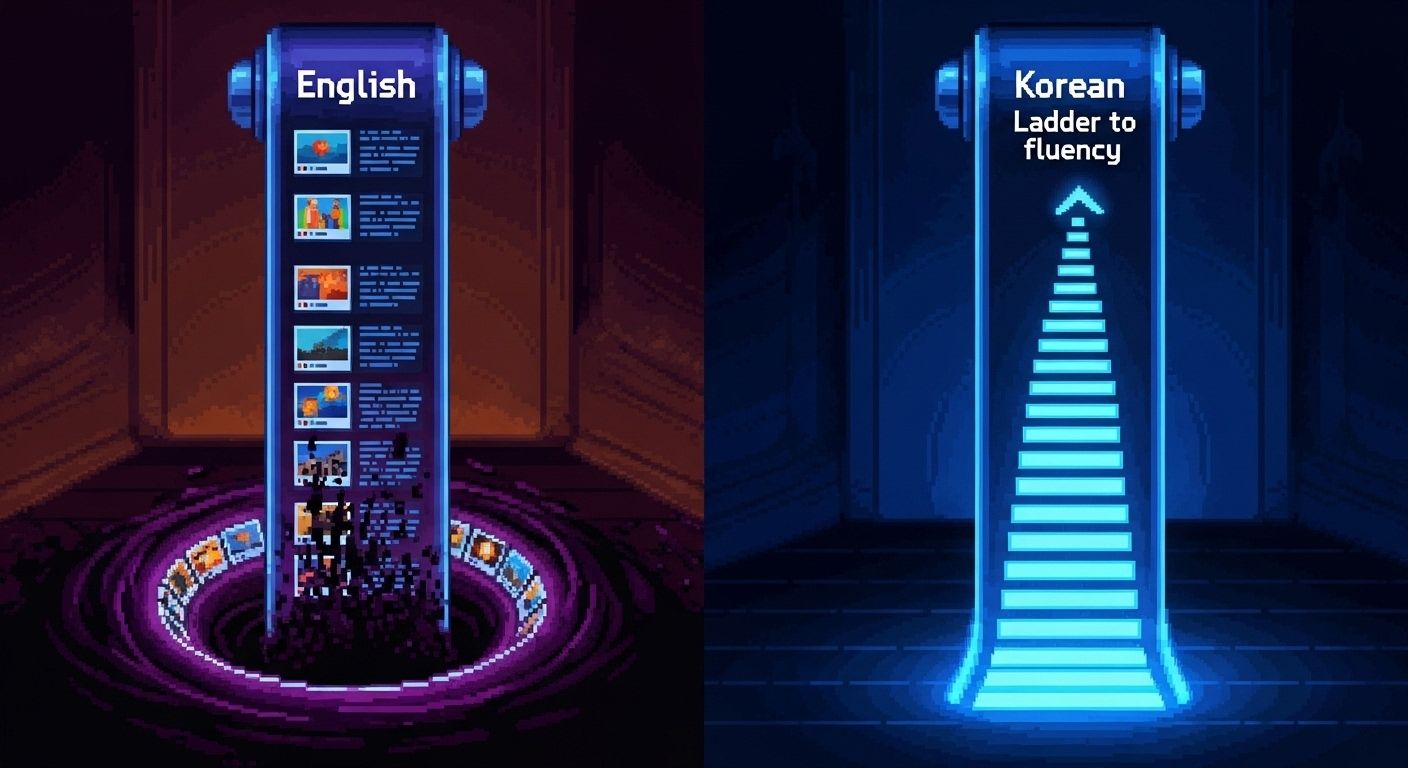
The English scroll wheel knows us too well. It studied us for years. Our laughs, our pauses, our guilty pleasures. It knows that after the highlights, we want the commentary. After the commentary, the drama. After the drama, the meme. It's a sophisticated trap, refined through a billion hours of data, designed to keep us exactly where we are. Entertained, dopamine-saturated, and fundamentally unchanged.
Nobody sits down planning to scroll for three hours.
We don't wake up and think "today I'm going to lose two hours of my life to Instagram." We open the app because something caught our attention. Then that video leads to another. And another.
The trap of the scroll wheel is how effortlessly it works. Once you're caught by one thing, the next thing has just enough to keep you there. You don't have to make any decisions. Just flick your thumb.
A couple of scrolls later, the sun is down. You're wondering where your day went.
I don’t know about you but that feeling for me is quite sickening.
Not physically ill, but spiritually depleted. We got some laughs. We sent some videos to friends. But in our gut, we know. We just traded three irreplaceable hours of our finite lives for nothing we can keep. The algorithm fed us, but we didn't grow. We consumed a feast and somehow left malnourished.
I know this feeling viscerally because I'm living it right now.
Instagram's algorithm has me figured out better than most people in my life. It knows every business rabbit hole I'll fall down, every writing insight I'll save, every entrepreneurial thought that keeps me up at night. Meta's engineers deserve props. They've built the most dangerous algorithm I've ever encountered.
And look, I'm in a healthier place with it now than I used to be. Having projects helps. Having purpose helps. I've shifted from being just a consumer to being more of a creator. That reframe alone has given me some breathing room. I've built systems. I've turned off notifications so my time on these apps is dictated by my intention to be there for something specific, not by some red dot screaming at me.
But I'm still human. I still catch myself scrolling longer than I'd like sometimes.
This isn't some confession from my past. This is my Tuesday.
The sick feeling in my stomach after those sessions used to be much more real. Back before I had projects pulling at my attention, before I started learning Korean, I would lose entire days to the scroll. Now? I have more control. Not because I defeated the algorithm, but because I built awareness around how it works and how my brain responds to it. The pit in my stomach still shows up sometimes when I catch myself two hours deep in a rabbit hole I didn't plan to enter. But it's different now. I'm not helpless. I'm just human.
Most of us talk about disconnecting from social media, about how we're "losing our lives." And the next day? We're all back. The algorithm has us. Not had. Has.
The average person spends 2 hours and 21 minutes per day scrolling on social media. That's over 800 hours per year. More than 34 full days of your life, annually, spent scrolling. Think about that.
Thirty-four days. That's enough time to:
Read 50 books
Become adept at a new skill
Have hundreds of meaningful conversations
Or become conversational in a new language
When someone tells me "I don't have time to learn a language," I take their word for it. I believe their schedule feels impossible. But somewhere in those 141 minutes of daily scrolling, there's time. Not new time. Redirected time.
Since Vine launched in 2013, we've had over a decade of platforms perfecting the scroll. By 2016, TikTok entered and changed everything. Then Instagram Reels and YouTube Shorts followed in 2020. These aren't accidents. They're the result of billions of dollars spent studying how to keep us scrolling.
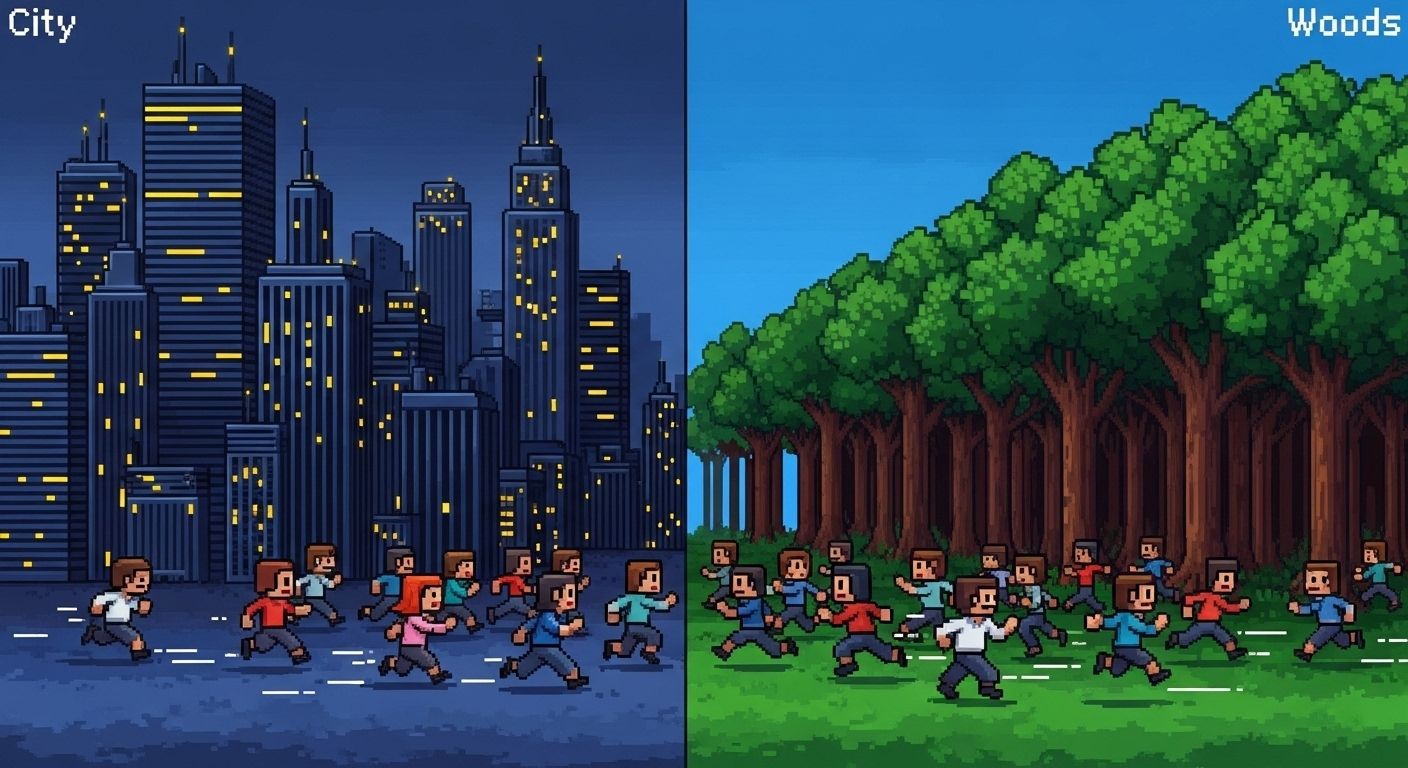
I'm not going to win by leaving. The whole "delete social media and live in the woods" thing sounds romantic, but I have goals that require being in the city. Social media is the city. The woods is not having it. But I need to figure out how to get into the city, do what I need to do, and come home without getting mugged every single time.
Because when you completely cut the relationship, you don't build any resistance. When you come back (and most of us do), you haven't built anything. No relationship with dealing with the pull. Some people get tired of pulling and fighting, so they give up entirely. I get it. It's exhausting.
But what if we stopped fighting?
What if we redirected instead?
Now Imagine The Same Scroll, But Every Video Is In Korean
At first, it feels like punishment. The algorithm is trying to grab us, but we're slippery. We don't understand enough to get fully hooked yet. We watch thirty seconds and think, "What did he just say?" We look up a word. Our brain works. The hook doesn't catch as easily because comprehension creates friction.
But that friction is growth.
Every moment we spend in the Korean scroll wheel, something different happens.
You're not just being entertained. You're training your ear. Each scroll is reps. Each video is practice you don't have to force yourself to do.
That comedian's joke you didn't quite get? You pause. You think. You figure it out. That word you heard three times this session? It's carving itself into your memory through sheer frequency. The algorithm is still trapping you, still keeping you scrolling. But now the trap is lined with vocabulary used by native speakers in native contexts. Grammar patterns used in the speech of the people you want to talk to and talk with, not the patterns you study in chapter 25 of your textbook. Cultural references. Slang. Trendy words (유행어). Popular phrases of the time. The kind of language you can't get in a textbook. The kind you only get by hearing it, by being there.
When we finish a three-hour Korean scroll session, we feel different. Tired, yes. But not depleted. We're tired the way our muscles are tired after a workout. We spent three hours, but we didn't waste them. The algorithm grabbed us by the throat, but instead of dragging us backward, it pulled us forward.
The same algorithmic trap. The opposite outcome.
This is the core revelation. We don't need to defeat the algorithm. We're probably not going to anyway. These systems are designed by the world's best engineers specifically to be irresistible. Fighting them is like trying to swim against a riptide.
Instead, we redirect the current.
We let the algorithm keep its grip on us, but we make sure it's gripping us in Korean, in French, in Japanese. Now when it pulls us down the rabbit hole, every click is a win. Every thumbnail is vocabulary practice. Every autoplay is listening comprehension.
How To Build Your Algorithm (The 30-Minute Investment)
Building an algorithm that works for you takes maybe 30 minutes of deliberate work. Thirty minutes to remove the next two years of decision paralysis, of questioning whether you're good enough to watch this, of stressing about what to click.
If I told you that you'd never have to stress about finding content in your target language again, that all it took was 30 minutes to remove that stress, would you do it?
Imagine. You look at the clock. The sun is dropping. You've been scrolling for two hours. But instead of that pit in your stomach, instead of thinking "son of a bitch, my entire day is gone," you think this: "Holy cow, I just spent the past two hours in Korea and I didn't even feel like it."
That's not just a nice feeling. That's life-changing. And it takes less than 30 minutes to set up.
Here's exactly how to do it.
Step 1: Pick Your Platform (And Consider a Fresh Start)
The platform matters less than your commitment to stay on it. Pick the one you already waste the most time on. That's your scroll wheel. Don't fight your existing habits. Redirect them.
But here's something critical that most people overlook.
In last week's newsletter, I talked about watching what your target language mirror self would watch. Creating a space where your English self has its own domain, but making a separate place or profile for your target language self.
For some of us, the thought of unfollowing everyone or unsubscribing from years of carefully curated content feels impossible. Why would I unravel five years of algorithm training? The algorithm knows me so well.
You don't have to.
Make a new account. A fresh Instagram. A new Twitter. A separate YouTube profile (you can keep your premium benefits, which is elite). Start with a clean slate.
You don't need to wrestle with the past anymore. You can start clean. That's what I did for my YouTube profile.
This isn't specific to Korean. This works for any language.
Step 2: Find 5-10 Accounts That Post Native Content
This is the work. But it's only 30 minutes of work.
Search for comedy accounts, street interviews, cultural content, cooking shows. Anything that actual native speakers watch for entertainment, not language learners. If it has subtitles in English, it's not for you. If it's "teaching" you the language, it's not for you. You want the real thing. The stuff locals watch.
When I started with Korean, I searched "한국 코미디" (Korean comedy). I found Comedy Big League. Actual professional comedians in Korea performing rehearsed comedy acts. It's not stand-up. It's more like theatrical comedy, like plays. I'd never really seen how comedy worked abroad, so it caught my attention.
I didn't understand most of it at first. That didn't matter.
The more I watched, the more I found what I liked. They have different skits. It started as curiosity. Then it turned into genuine entertainment. I found my favorite skits. My favorite comedians.
If you see your target language in the account's posts, that's the sauce. If you can identify that it's made by them for them (not for learners), you're in the right place. If you watch more than 10 seconds, follow.
Follow every account that posts content you find even remotely interesting. Don't overthink it.
Step 3: Interact With Everything (And Understand What The Algorithm Actually Tracks)
Now comes the algorithm training.
Like every single video. Comment on some (even if it's just an emoji). Save the ones that make you laugh or that you want to rewatch. Watch videos all the way through. Even if you don't understand. Especially if you don't understand.
The algorithm is watching. It's learning.
But here's what most people don't understand. The algorithm doesn't care what you say you "like." It cares where you linger.
If you linger on English videos for the entire view time and scroll past Korean videos in two seconds, the algorithm is picking that up. If Korean content is what you watch till the end and English content is what you bounce from, the algorithm is picking that up.
The language of the content is one of many signals. Your behavior is the loudest signal.
When you're training your algorithm, you need to be aware of this. YouTube's algorithm, in my experience, is the easiest to train. You can delete your history. You can delete your search history. You can remove English videos from your feed. I've done it multiple times with multiple languages.
Instagram is trickier. I've done it once or twice, but Instagram's algorithm is more nuanced. For me, Instagram is where I lose myself more with English content. My Instagram algorithm needs training because I'm not in a place where Korean even feels like learning anymore. It's just entertainment, which is the dangerous part. Once you get to a certain proficiency, the algorithm can still be a problem if you're not careful.
That's why having a separate account for your target language content gives you your own space. A place where you can say, "I don't want to be in the English algorithm right now. Let me give myself my target language algorithm instead."
Step 4: Starve Your English Algorithm
This is critical and most people skip it.
For the next week, scroll PAST every English video immediately. Don't watch. Don't like. Don't comment. Train the algorithm to understand:
English content = this user bounces.
[Target language] content = this user stays.
It feels weird at first. You'll see videos in English you want to watch. Resist. You're not quitting English content forever. You're just training your algorithm to prioritize Korean.
Step 5: Watch The Transformation (7-10 Days)
In about a week, you'll notice something magical. Your entire feed is Korean. Or Spanish. Or Japanese. Whatever language you trained it on.
Now when you open the app (the same app that used to steal hours of your life in English), it immediately throws you into your target language. No searching. No deciding what to watch. No clicking through menus wondering if you're "good enough" for this content yet.
You just scroll. And every scroll is comprehension practice you don't have to force yourself to do.
Step 6: Let It Work
Over the next few months, something happens that you can't predict.
The algorithm will show you the same creators repeatedly. You'll start recognizing their voices, their speech patterns, their humor. You'll hear the same words and phrases over and over in different contexts. Your brain will start connecting dots you didn't know existed.
You're not studying. You're just enjoying content. But the learning is happening automatically, in the background, through sheer exposure.
When I discovered Comedy Big League, I'd find myself watching for hours, genuinely laughing, genuinely entertained. But I was also absorbing. Speech patterns. Timing. The way Koreans structure jokes. How they express surprise or react to absurdity.
The English algorithm makes us passive consumers. The target language algorithm makes us active acquirers.
The Beautiful Irony
The Korean scroll wheel eventually deters excessive scrolling naturally.
Looking up words is work. Processing unfamiliar grammar is work. Your brain gets genuinely tired. Not that fake dopamine-crash tired, but the good tired of genuine effort. So you close the app earlier. You do something else. The algorithm's grip loosens not because you fought it, but because you changed its nature.
You turned your captor into your coach.
But let me be clear about something. The scroll wheel is still an entertainment machine. It's still built to grab you with the things you subconsciously desire but haven't even consciously admitted to yourself yet. That's the cryptically funny part about it.
It will still hold you. That hasn't changed.
What has changed is what the time feeds.
The time you used to spend scrolling English content felt empty afterward. You got the dopamine hit in the moment (a bunch of dances, a bunch of funny memes, some laughs), but then came the crash. In the moment, sure, it felt fine. But after? That pit in your stomach. That spiritual depletion.
Now that same time, that same scroll, that same algorithmic grip, it's feeding something different. It's feeding your learning.
You're building a subconscious frequency list through this exposure. That might sound abstract, but it's incredibly practical. Your brain, without you even trying, starts tracking what words and phrases show up most often. What patterns repeat. What structures you keep encountering.
And then, when you do sit down to study (my frame is one hour of focused work where I look things up), you're not staring at a blank page wondering "what should I even study?" Your brain has receipts. It has data. It throws things to your conscious mind that caught your attention during all that exposure.
For me, my study time is when I have my dictionary open and I'm looking up stuff. My habit is every 3 minutes I want to catch at least one or two things that grab my attention in whatever long-form video I'm watching or book I'm reading. That habit works because of all the exposure I've had. The exposure gives my brain something to work with.
If someone tells you "here are 20 words in this sentence, but you can only look up one or two," that statement is hell for most learners.
How do you know which ones are the “right” ones?
You won't know. Not at first. But you can give yourself an inkling of the frequency. You can give yourself something that creates a better itch for which words to prioritize.
The more content you consume, the better your itches get. The more your ear gets attracted to looking up certain words. And that attraction comes from the time you spent with all that input.
You've added time without adding time. You've cut the time you were honestly hating (the empty English scroll), and redirected it toward something that feeds your goals. The algorithm that everyone talks about being the enemy to your life improving? You can use it toward your goals.
I'm not telling you to scroll for 20 hours when you have a life to live, a family to take care of, potentially a school or a degree to finish. That's not realistic and you know that.
What I'm saying is this: The time we do spend with the algorithm, I'd rather it move me in the right direction. I'd rather have a ladder than a black hole.
For me, my system for staying out of the Instagram black hole involves being intentional. I have projects I'm working on. I consciously won't allow myself to fall into certain rabbit holes because I know how the algorithm works, I know how my brain works, and I've built awareness around the faults I have and the actions I'm responsible for.
I'm responsible for my time. I'm responsible for how my time is used. If I get sucked into a rabbit hole, the accountability still rests on my shoulders. But my control has only grown as I've become more aware of this reality. The more you think the world is the only thing that happens and you have no control, that's a cop-out. Be aware of the ways you're affected by the world. Understand yourself well enough to change your environment.
I'd rather shape my environment toward my goals than completely leave the world. Like I said, I need to work in the city to do what I love. Completely cutting social media out of my life would mean cutting out my ability to help people in the ways I can. There are benefits to it. There are negatives. We have to be aware to deal with the negatives more effectively.
A Note On How This Sounds
Look, I've been living this way for five years, so I'm deep in it. To someone who doesn't see the point of learning a language, anything we do that's less convenient than doing it in our native language probably looks like a waste of time. Or kind of stupid. "Why would you do that?"
But when you understand the weight of the goal, when you really grasp what it means to want fluency, everything changes.
What are we actually trying to achieve when we say we want to be fluent? We're trying to reach a point where we can communicate our intentions accurately in a language and culture we respect. We don't want to be the people who translate things in our phones and then feel stupid when those things aren't received the way we intended.
We don't want to miss a word and ruin a conversation. We don't want to misuse something and feel that pit in our stomach.
Yeah, we're human. It happens. We make mistakes.
But there's a difference between making mistakes as data to improve from and making mistakes because we never built the foundation. I want to champion the people who see their mistakes and want to improve. That's something worth celebrating.
I need to be clear about something, though. I'm not embarrassed by the things I did to get good at Korean. I'm actually blessed when I look back at that. Maybe with rose-tinted glasses, maybe not, but I built my way to where I am right now. It wasn't perfect (nothing in this world is), but I sure as hell know that where I stand, I have a level of pride and thankfulness to my past self.
There are certain things I know certain people would never do, but I'm aware of that reality. I know my goals aren't the same as everyone else's and I'm at peace with that. I'm at peace with the reality that I'm doing something 99% of people could never see themselves doing. And that's okay.
After 5 years of doing this consistently, committed to it despite the fact that there's a world of people who will think of you as crazy for wanting to learn a language and then learning it with this level of intention, my goal here was always to be able to distill this language learning thing in a way that doesn't seem as radical.
I want to paint and explain the psychology behind achieving exceptional goals. That's something I've always been passionate about expressing. That's the reason I want to lead many of you who might be feeling those things I used to feel, but help you understand that getting there doesn't need to feel that way.
Environment vs. Willpower
Something my friend told me the other day crystallized this whole thing.
"If you sit in a barber shop every day, you're going to get a haircut eventually."
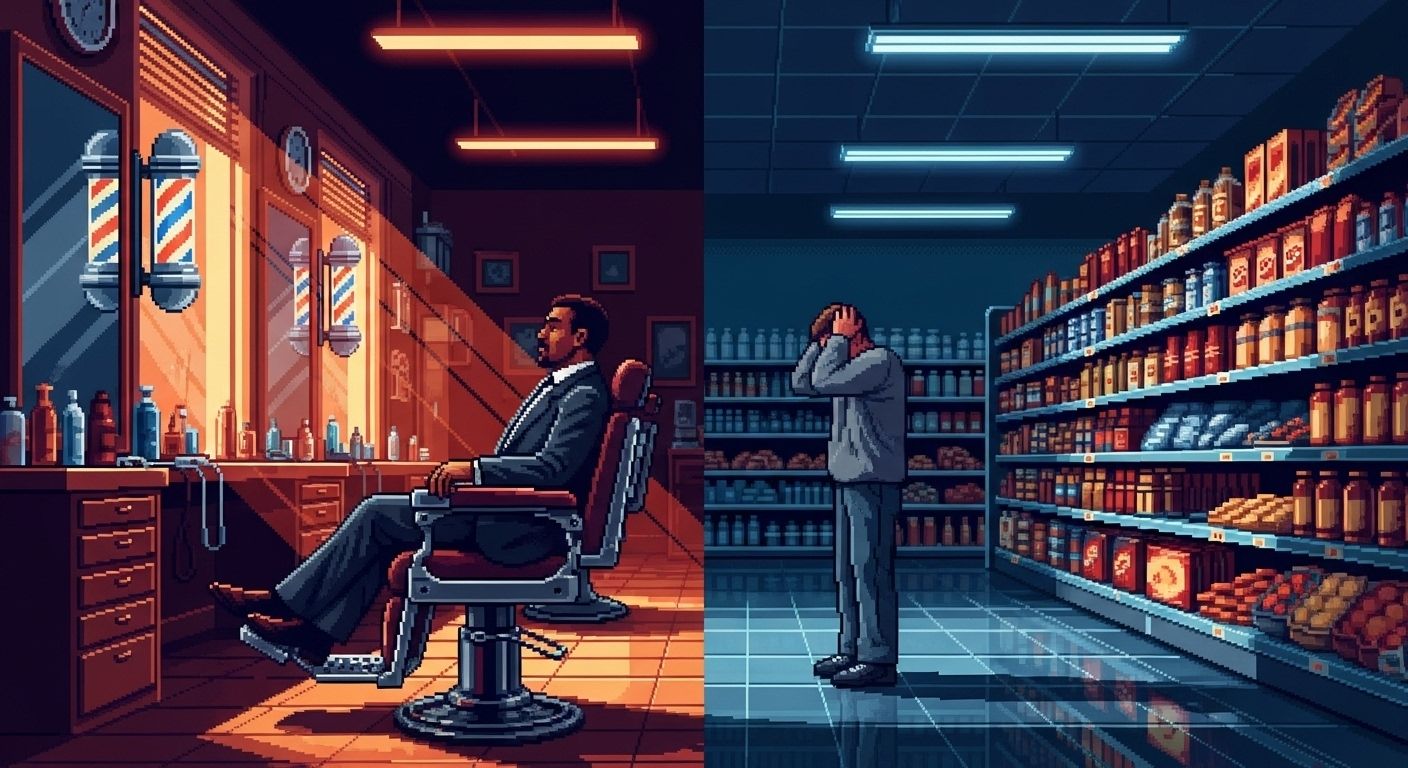
You might not walk in wanting one. You might not plan on it. But if you sit in a barber shop long enough, somehow, someway, your hair is going to find those clippers.
Intention doesn't have to start with intention. Intention can be created by your environment.
This is peer pressure. This is why we can't lock someone struggling with weight loss in a supermarket with free food. This is why your immediate space (the thing in your hand, in your pocket) matters so much.
If that thing is calling you to do things you ideally don't want to do, and you keep telling yourself "I'm not a person who does that," what happens when you accidentally do that? It crushes you. It hurts.
Disconnecting your identity from your actions frees you from that pain. You don't have to be "a person who never scrolls" or "a person who's above the algorithm." You can be someone who sometimes falters but uses awareness to give yourself more control.
That balance (awareness plus control) is what separates someone who's mentally and emotionally stable from someone who's constantly at war with themselves.
I'm not trying to defeat my Instagram addiction through willpower. I can't. Meta's engineers are smarter than my discipline. But I can redirect it. I can make sure that when I inevitably scroll (because I will, we all will), the scroll is working for me instead of against me.
When your environment is your target language, you're sitting in the barber shop you actually want to be in. And eventually, without forcing it, without fighting it, you're going to walk out fluent.
Thank you for reading! Hope this was helpful.
When you’re ready, here’s how I can help you further:
Read last weeks letter, How To Learn Any Language Like You're Already Native here
Try Migaku, (Get 1 months free via my link) my do it all immersion app
Follow me on X for nuggets of lang & life insights, from yours truly
Get immersed in my full K web-drama immersion playlist here
Happy immersing,
ㅡ Ade